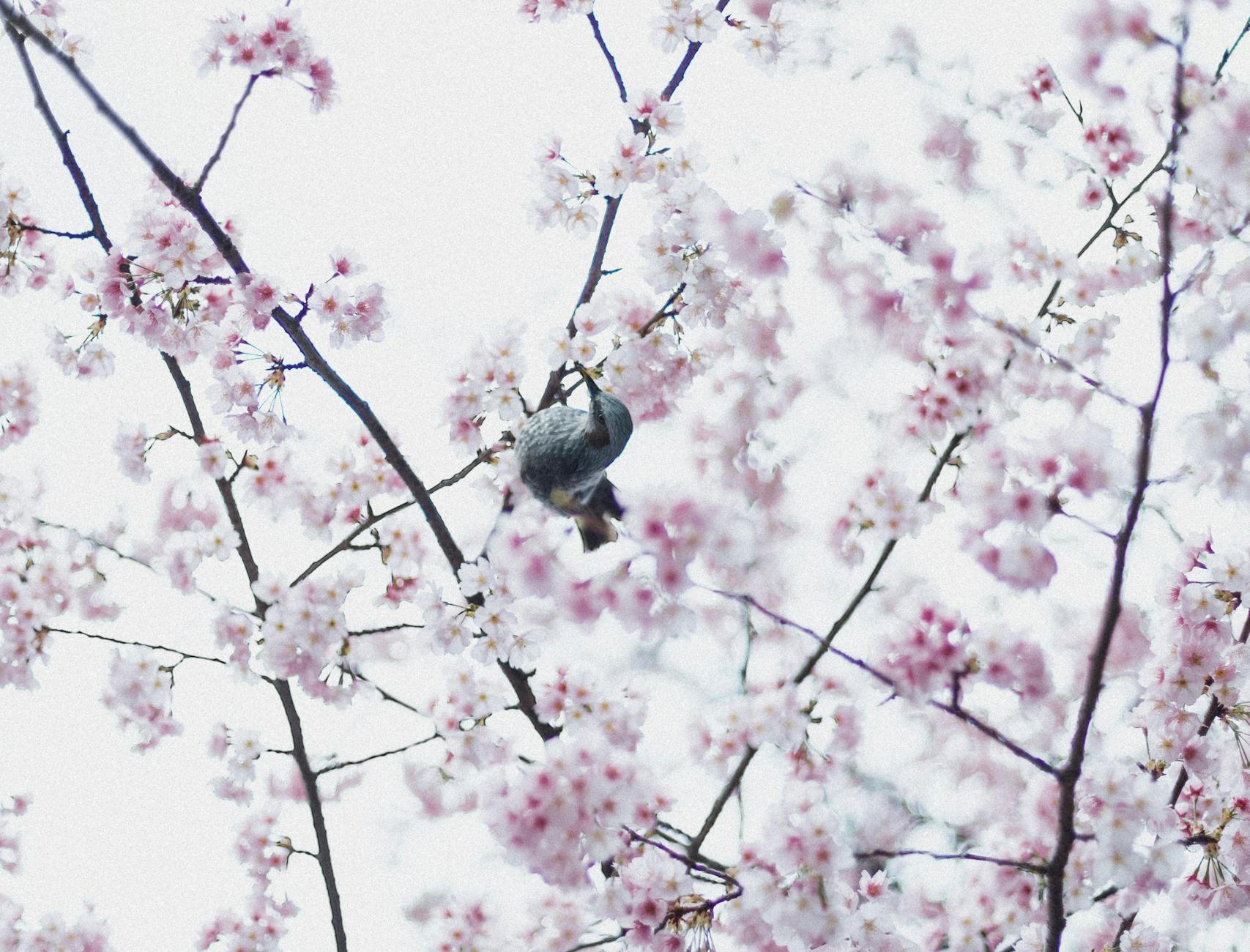
If Tokyo has a cultural heart, it beats loudest in Ueno. This remarkable district in the city’s northeast packs more genuine substance into a single neighbourhood than most cities manage in an entire downtown: Japan’s largest collection of world-class museums, the country’s most famous zoological garden, a historic Shinto shrine gilded in gold leaf, a vast public park that becomes the most celebrated cherry blossom venue in the country each spring, and one of Tokyo’s great open-air markets — all within comfortable walking distance of each other.
Ueno doesn’t dazzle with neon or overwhelm with scale. It rewards curiosity, patience, and appetite — for art, for history, for fresh seafood at 300 yen a skewer, and for the kind of Tokyo that has existed long before any tourist infrastructure was built around it. This is the complete guide to things to do in Ueno in 2026.
Ueno Park — Tokyo’s Greatest Public Space
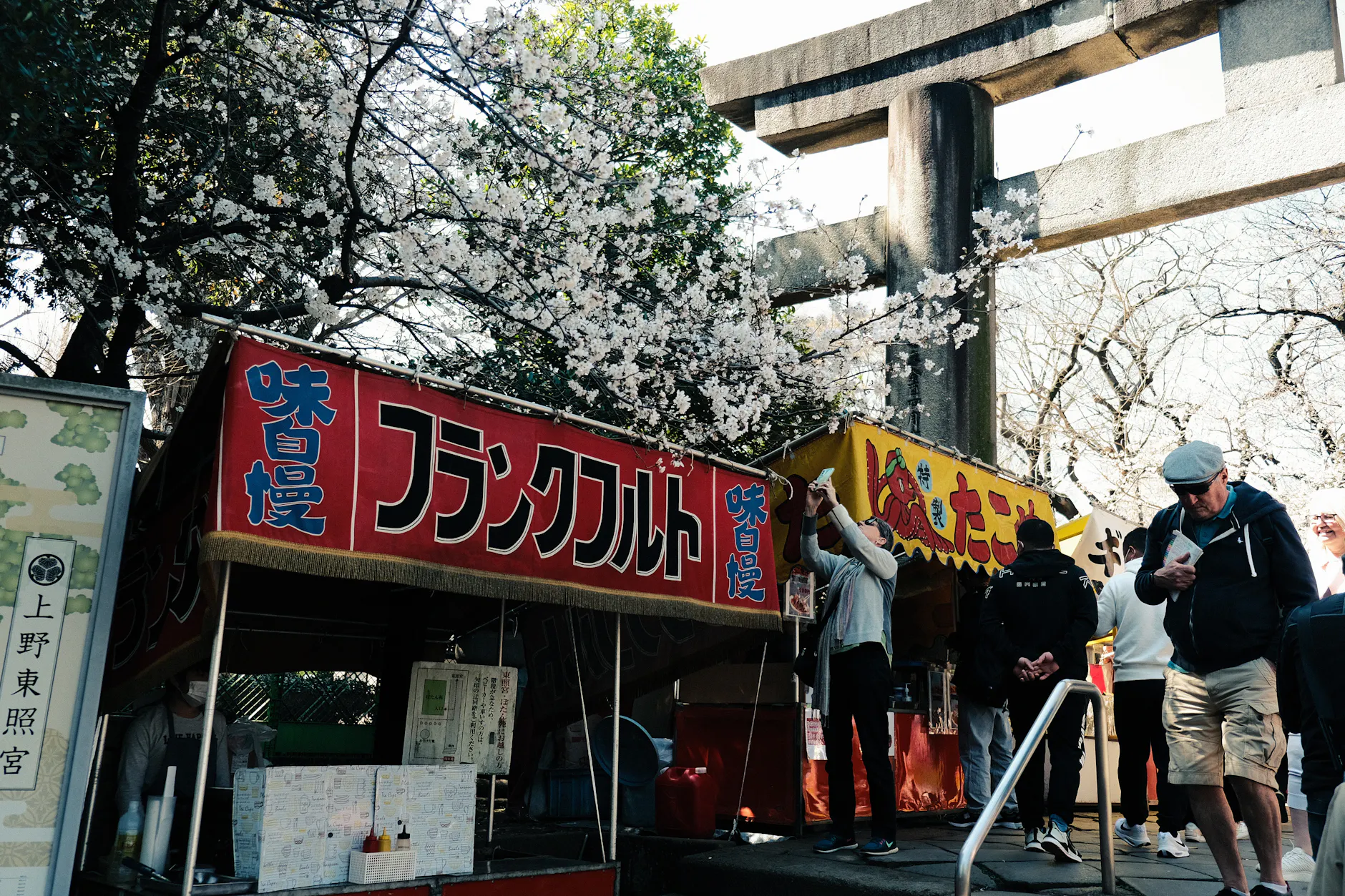
Ueno Park (Ueno Onshi Koen) is one of Japan’s most famous public parks and forms the backbone of the entire Ueno experience. Opened in 1873 as one of Japan’s first Western-style public parks, it covers approximately 53 hectares and serves as the green campus around which Ueno’s cultural institutions are gathered.
Entry to the park itself is completely free, and simply walking through it is worthwhile at any time of year. The main avenue from the park entrance leads past the Tokyo National Museum, multiple other museum buildings, Toshogu Shrine, and down toward Shinobazu Pond. The sense of being in a purposefully curated cultural landscape — with grand museum facades, stone lanterns, old trees, and the occasional shrine gate appearing through the foliage — is unlike anywhere else in Tokyo.
Ueno Park works equally well as a half-day or a full-day destination, depending on how many museum visits you include. Families with children have the added attraction of the zoo. Those visiting in late March or early April have one of the world’s great natural spectacles: roughly 1,200 cherry trees in simultaneous bloom, with food stalls and celebration filling every path.
Ueno Zoo — Japan’s Oldest Zoo
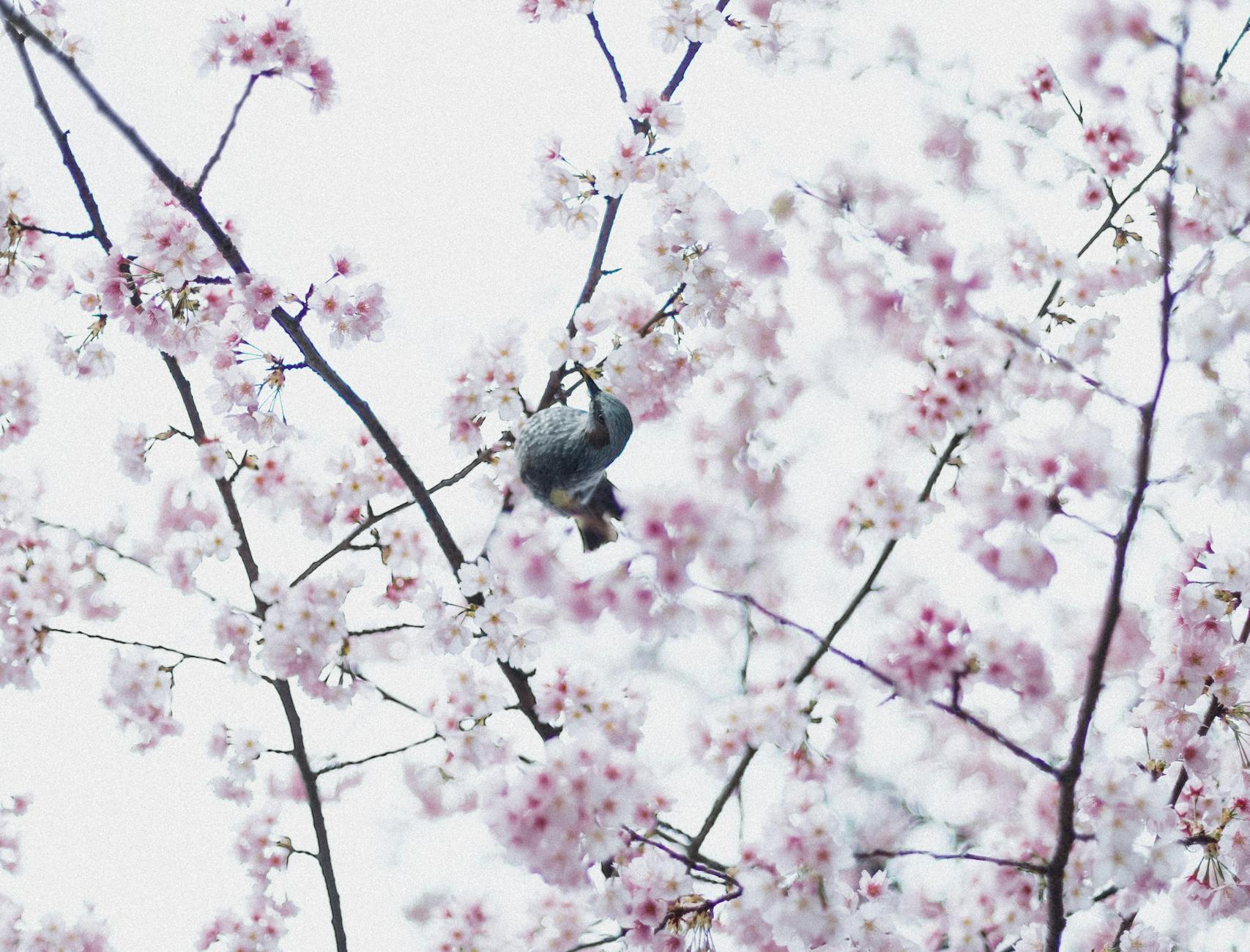
Ueno Zoo (Tokyo Zoological Park) opened on 20 March 1882, making it Japan’s oldest zoo and one of the oldest in Asia. It is one of the most visited zoos in the world, regularly welcoming upward of 3 to 4 million visitors annually, and houses approximately 300 species across its east and west garden areas, connected by a monorail.
The zoo’s most famous residents are its giant pandas. Ueno Zoo received its first panda in 1972 following diplomatic exchanges between Japan and China, and giant pandas have been a fixture — and a national obsession — at the zoo ever since. Current panda residents include cubs born in recent years, and panda-related merchandise fills the entire gift shop. Queues to see the pandas can be long on weekends; arriving at opening time is strongly recommended.
Beyond the pandas, the zoo is home to gorillas, tigers, polar bears, giraffes, elephants, and a large reptile house. The western garden has a children’s area particularly popular with families.
Important
Ueno’s World-Class Museums
Nowhere else in Japan — arguably nowhere else in Asia — offers such a concentration of major museums within a single walkable area. Ueno Park is home to four nationally significant institutions, each of which could fill a half-day on its own.
Pro Tip
Tokyo National Museum
The Tokyo National Museum (TNM) is the largest museum in Japan and one of the largest in Asia, housing more than 120,000 objects — the largest collection of Japanese art and antiquities in the world. The main Honkan building (Japanese Gallery) displays the full sweep of Japanese artistic history: ancient ceramics, Jomon-era pottery, Buddhist sculptures, samurai armour and swords, Edo-period paintings, ink drawings, textiles, and No theatre costumes. The Toyokan (Asian Gallery) covers art from across Asia including China, Korea, Southeast Asia, and the Indian subcontinent. Admission starts at approximately 1,000 yen and special exhibitions carry additional charges.
National Museum of Nature and Science
The National Museum of Nature and Science (Kokuritsu Kagaku Hakubutsukan) is one of Japan’s most beloved family museums, covering natural history, science, and technology across two major buildings. Highlights include dinosaur skeletons, a life-size model of a blue whale suspended from the ceiling, exhibits on Japanese flora and fauna, and the Science and Technology History Hall documenting Japan’s extraordinary industrial modernisation. Admission is approximately 630 yen for adults; children under middle school age are free.
National Museum of Western Art
The National Museum of Western Art (Kokuritsu Seiyou Bijutsukan) is housed in a building designed by Swiss-French architect Le Corbusier — one of a collection of 17 buildings around the world that were granted UNESCO World Heritage status in 2016 for their contribution to the modern architecture movement. The permanent collection includes an outstanding assembly of Impressionist and Post-Impressionist works (Monet, Renoir, Pissarro, Manet), as well as Old Masters and 20th-century European art. The forecourt features original casts of several Rodin sculptures. Admission approximately 500 yen.
Tokyo Metropolitan Art Museum
The Tokyo Metropolitan Art Museum focuses on rotating special exhibitions rather than a permanent collection, hosting major international touring shows alongside Japanese contemporary and classical art exhibitions. Check the schedule before your visit — the blockbuster shows here routinely sell out weeks in advance. The building itself, designed by Kunio Maekawa and renovated in 2012, is architecturally interesting. Entry fees vary by exhibition.
Ameyoko Market Street
Ameyoko is one of the most atmospheric and genuinely alive market streets in all of Japan. Running approximately 400 metres between Ueno Station and Okachimachi Station along the elevated JR train tracks, Ameyoko is part outdoor bazaar, part fresh food market, part discount shopping strip, and one of the best places in Tokyo to eat while standing up.
The market has a fascinating origin story. After World War II, when rationing and scarcity defined everyday life, a black market grew up along these tracks selling American goods — candy, chocolate, cooking fat, clothing — smuggled or obtained from US occupation bases. The name Ameyoko likely derives from either Ameya-yokocho (Candy Shop Alley) or America-yokocho (America Alley), and both derivations are historically accurate. By the 1950s the market had been legitimised, and today it operates as a legal, thoroughly vibrant strip of commerce.
What you’ll find in Ameyoko today:
- Fresh seafood — vendors shouting prices for whole tuna, king crab legs, live shellfish, dried squid, and fresh sashimi-grade fish. The energy is extraordinary, particularly in the run-up to New Year when competition is fierce and prices drop dramatically.
- Dried goods and snacks — nuts, dried fruits, seaweed, bonito, Korean kimchi, rice crackers
- Street food — skewered yakitori, takoyaki (octopus balls), deep-fried gyoza, fresh-cut fruit, and creamy scallop skewers
- Discount clothing and fashion — particularly sportswear, outdoor gear, and branded fashion at reduced prices
- Cosmetics and health products — popular with shoppers from across Asia for discounted Korean and Japanese skincare
Important
Ueno Toshogu Shrine — The Golden Hidden Gem
Tucked within the trees of Ueno Park, and overlooked by most of the tourists rushing between the zoo and the museums, stands one of Tokyo’s most breathtakingly beautiful shrines: Ueno Toshogu. Built in 1617 and dedicated to Tokugawa Ieyasu — the shogun who unified Japan and established the Edo period (1603 to 1868) — this is one of the few structures in Tokyo to have survived the devastation of the 1923 Great Kanto Earthquake, the 1945 firebombing raids, and subsequent development with its original Edo-period architecture intact.
The approach to the shrine is lined with approximately 200 stone lanterns — donated by feudal lords from across Japan in tribute to Ieyasu — creating one of the most atmospheric walkways in the city, particularly in misty weather or at dusk. At the end of the lantern-lined path stands the Karamon (China Gate), its elaborate gilded carvings depicting cranes, peonies, and mythological creatures rendered in extraordinary detail. The gate and surrounding shrine buildings are covered in gold leaf and intricate painted carvings that rival the famous Toshogu at Nikko for decorative ambition.
Beyond the Karamon is the main hall (Honden), which is surrounded by more gilded and painted panels. The entire effect is one of opulent, concentrated magnificence — all the more striking for being tucked quietly within a public park surrounded by museum buildings and zoo visitors entirely unaware of what lies a few hundred metres off the main path.
- Entry: Free to walk the outer approach and view the gate. Inner precincts: approximately 500 yen for adults
- Opening hours: Generally 9:00am to 5:30pm (closes earlier in winter)
- Best time to visit: Weekday mornings, when you may have the lantern path almost to yourself
In February, Ueno Toshogu hosts the Botan Festival (peony festival), during which hundreds of peony plants bloom within straw-roofed protective covers along the shrine path — a uniquely beautiful winter sight.
Shinobazu Pond and the Lotus Garden
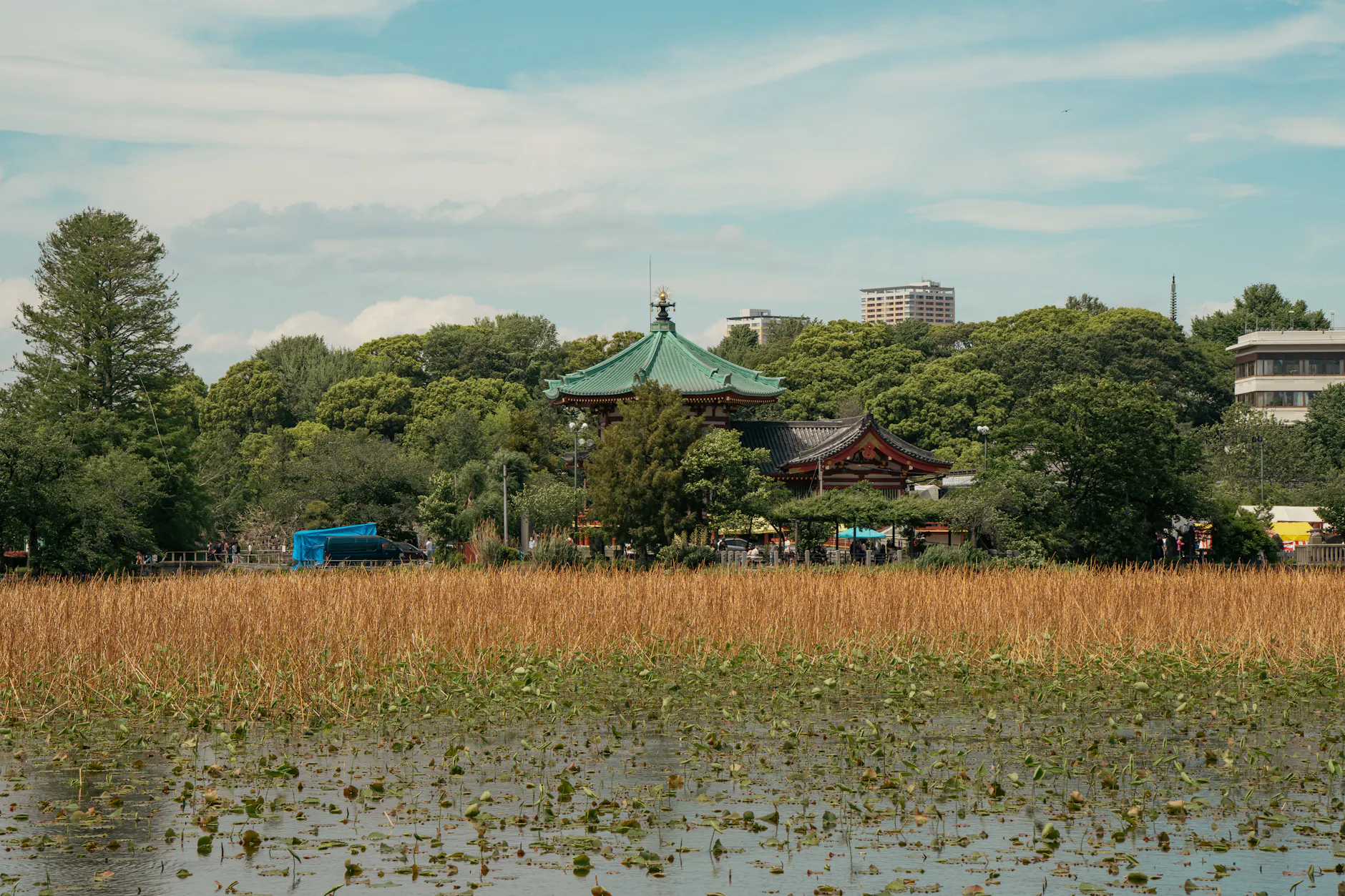
At the southern end of Ueno Park lies Shinobazu Pond, a large natural pond that provides an unexpected moment of calm and natural beauty within the urban district. In summer, the pond’s surface is almost entirely covered by the broad leaves and pink blossoms of thousands of lotus plants — one of the most striking natural sights in central Tokyo, and a phenomenon that has been celebrated in Japanese art for centuries.
At the centre of the pond sits a small island connected by a causeway, on which stands Benten-do — a picturesque octagonal shrine dedicated to Benzaiten, the goddess of everything that flows (water, time, music, words, and knowledge). The red shrine structure reflected in the lotus-covered water is a classic Tokyo photograph.
For a more active experience, rowboats and swan paddle boats can be rented from the boathouse on the western edge of the pond. Pedalling a pink swan boat through a carpet of lotus flowers while the Tokyo Skytree looms on the horizon is a surreal and entirely enjoyable experience.
The eastern section of the pond is managed as a nature preserve for migratory birds, and in winter the water is filled with ducks, cormorants, and other waterfowl. The whole area is free to enter and explore.
Ueno Street Food and the Food Scene
Between Ameyoko’s outdoor stalls and Ueno’s cluster of long-standing restaurants, this is a genuinely excellent neighbourhood for eating.
Ameyoko Street Food
The market stalls offer some of the most accessible street eating in Tokyo. Standouts include fresh sushi and sashimi sold by the piece from seafood stalls, takoyaki cooked to order in front of you, yakitori grilled over charcoal, and creamy scallop skewers that have become one of Ameyoko’s most popular modern additions. Budget around 500 to 1,000 yen for a satisfying wander-and-eat experience.
Ueno’s Ramen Scene
The streets around Ueno Station have a solid concentration of ramen shops, ranging from classic Tokyo-style shoyu (soy sauce) ramen to rich tonkotsu (pork bone broth) variations. The lanes on the western side of the station, toward the exit for Ameyoko, are particularly well stocked. Budget 900 to 1,400 yen for a bowl.
Ueno Yabu Soba
Yabu Soba in Ueno is one of Tokyo’s historic soba restaurants, with a lineage stretching back decades, and considered a benchmark for hand-cut buckwheat noodles in the city. The interior retains a traditional, wood-panelled atmosphere. Order zaru soba (cold soba with dipping sauce) or hot kake soba for a proper traditional Japanese lunch. Expect to queue at peak times — it is that good.
Cherry Blossoms in Ueno
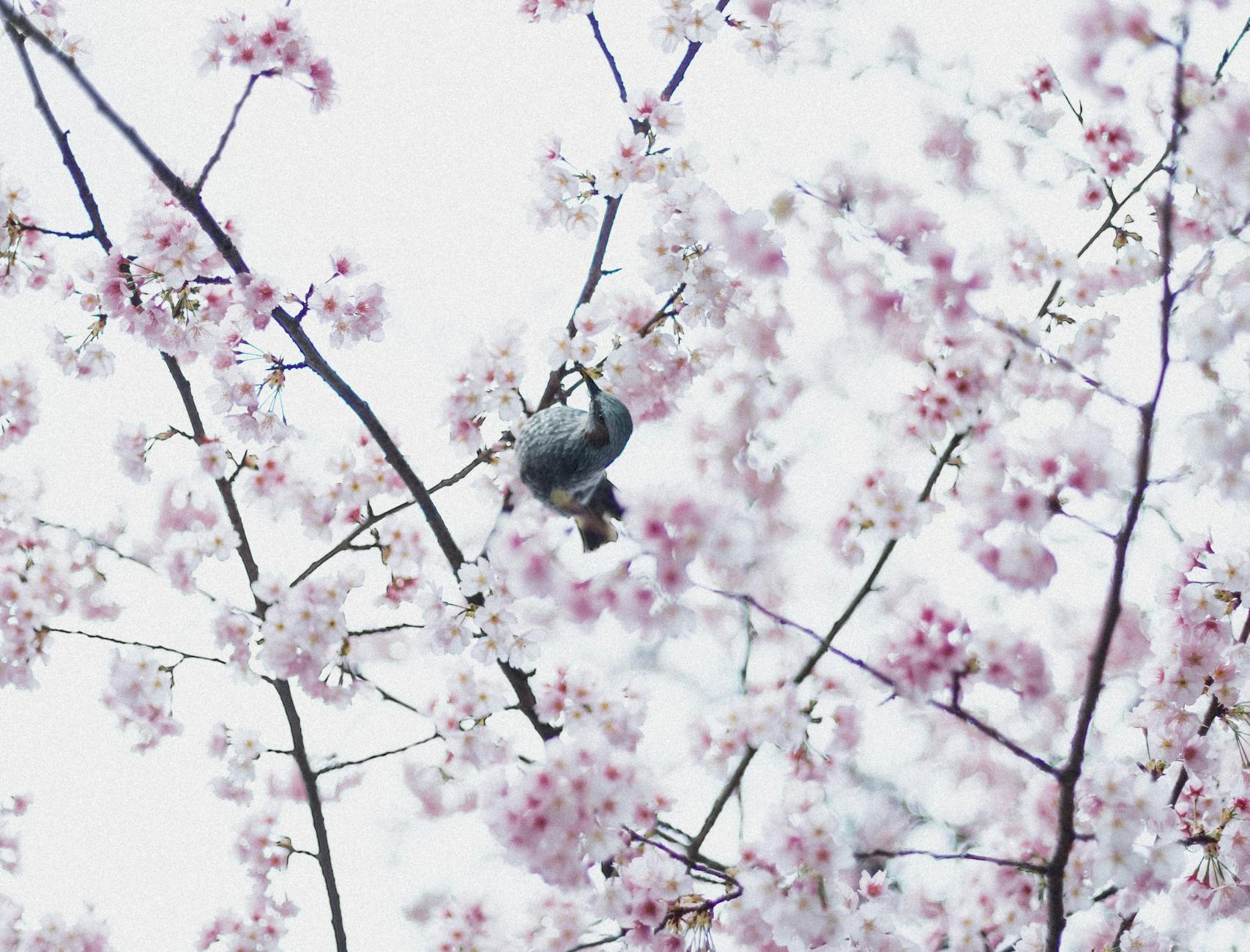
Every year, usually between late March and early April, Ueno Park transforms into what is arguably the most famous hanami (cherry blossom viewing) venue in Tokyo. Approximately 1,200 cherry trees line the park’s main avenue and surroundings, creating a tunnel of pale pink blossoms above the heads of thousands of picnickers, revellers, and photographers.
Ueno’s hanami scene is characterised by its festive, almost carnival atmosphere. Dozens of food stalls line the paths selling everything from yakitori and karaage to crepes and beer. Blue tarpaulins cover every inch of available ground as groups of friends, families, and office workers hold their outdoor parties (hanami parties) beneath the blossoms. The combination of delicate natural beauty overhead and lively human celebration at ground level is uniquely Japanese and unlike anything you’ll experience elsewhere.
Pro Tip
If you visit during cherry blossom season, plan to spend at least 2 to 3 hours in Ueno Park. The main avenue is best experienced in both directions — the view looking toward the museums is different from looking back toward the park entrance. Evening illumination events (yozakura) are also held in some years, extending the season experience into the night.
Getting to Ueno
Ueno is one of Tokyo’s major transport hubs, served by an extensive range of rail lines:
- JR Yamanote Line — the circular line connecting all major Tokyo stations; Ueno is a key stop, approx. 20 minutes from Shibuya, 5 minutes from Akihabara
- JR Keihin-Tohoku Line — runs parallel to the Yamanote through central Tokyo
- JR Joban Line — services to northern Tokyo, Saitama, and beyond
- Tokyo Metro Ginza Line — connects Ueno with Asakusa (one stop east), Akasaka-mitsuke, and Shibuya
- Tokyo Metro Hibiya Line — connects Ueno with Akihabara, Ginza, and Roppongi
- Keisei Ueno Station — a separate station a few minutes’ walk from JR Ueno; the departure point for the Keisei Skyliner express train to Narita Airport (approx. 41 minutes, 2,570 yen)
The park entrance is approximately a 3-minute walk from JR Ueno Station’s Park Exit.
Combining Ueno With Nearby Areas
Ueno is superbly positioned for combining with neighbouring destinations:
- Asakusa — 15 to 20 minutes on foot along the Kototoi-dori avenue, or one stop by Tokyo Metro Ginza Line. The two districts complement each other perfectly as a full-day cultural itinerary.
- Akihabara — approximately 10 minutes on foot from the south exit of Ueno Station, or one stop by JR. Go from world-class museum art to seven-story electronics stores in minutes.
- Yanaka — a 15-minute walk north of Ueno leads to Yanaka, one of Tokyo’s best-preserved old-town neighbourhoods, with a historic cemetery, traditional shotengai shopping street, and independent cafes and galleries.
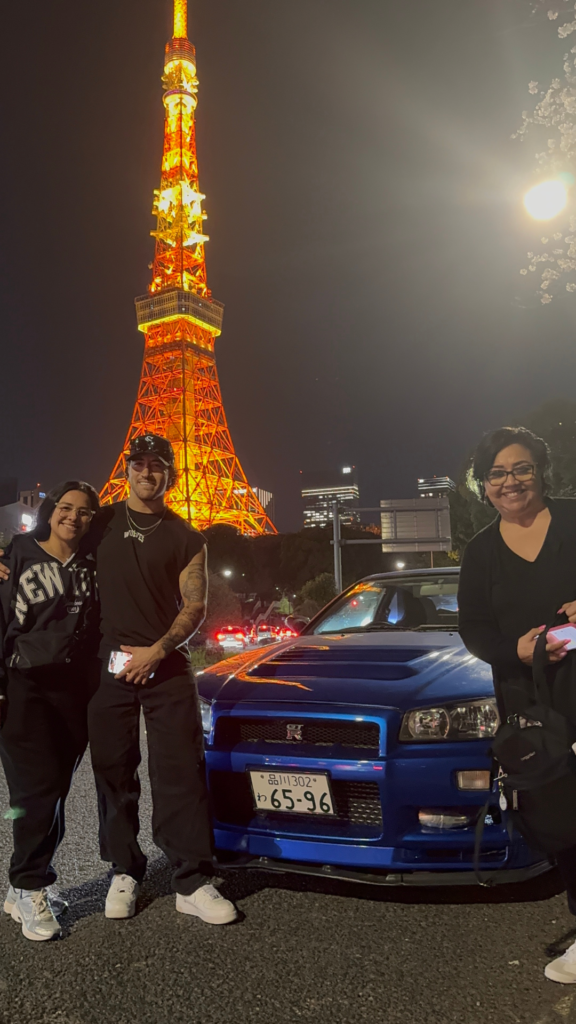
Rent a JDM car from our Shibuya base and include Ueno in your Tokyo driving itinerary — cruise the famous Kandagawa expressway route through the city’s northeast, park up near Ueno Station, and explore. It’s one of the best ways to experience how Tokyo’s cultural heritage sits alongside its urban infrastructure. Find out more on our JDM car rental Japan page.
JDM tour guide!
Step into the world of “Fast & Furious” with our exclusive Daikoku Tour!
Experience the legendary car meet atmosphere for yourself. Make it the ultimate highlight of your Tokyo trip!
Frequently Asked Questions About Ueno
Is Ueno worth visiting?
Ueno is one of the highest-value neighbourhoods in Tokyo for time spent. A single visit can encompass world-class museum collections, Japan’s oldest zoo, an atmospheric street market, a spectacular historic shrine, and seasonal natural beauty — all for a relatively modest budget, since Ueno Park itself and Ameyoko market are free. Whether you’re a first-time visitor or returning to Tokyo, Ueno consistently delivers.
How many hours do you need in Ueno?
A minimum of 3 to 4 hours covers the park, one museum, a walk through Ameyoko, and lunch. A full day (6 to 8 hours) allows you to visit 2 to 3 museums, the zoo, Toshogu Shrine, Shinobazu Pond, and a proper meal. During cherry blossom season, add 1 to 2 hours just for the park experience itself. If you’re combining with Asakusa on the same day, start at Ueno in the morning and walk to Asakusa in the afternoon.
Is Ueno Zoo good?
Ueno Zoo is excellent by global zoo standards, particularly for the quality and diversity of its exhibits and the rarity of some of its animals (giant pandas being the obvious headline). The zoo’s age (established 1882) means some of the older enclosures are smaller than modern equivalents, but ongoing renovation projects continue to improve conditions. For families with children, it is one of the best half-day activities in Tokyo.
What is Ameyoko market?
Ameyoko is a 400-metre outdoor market running along the elevated JR train tracks between Ueno and Okachimachi stations. It originated as a post-WWII black market and now operates as a legal, bustling strip selling fresh seafood, street food, dried goods, discount clothing, and cosmetics. It is one of the most energetic and authentic market experiences in Tokyo, and one of the few places in Japan where modest bargaining is culturally acceptable.
Is Ueno close to Asakusa?
Yes — very close. The two districts are approximately 1.5 to 2km apart and easily connected by a 15 to 20 minute walk or one stop on the Tokyo Metro Ginza Line. They are commonly paired together as a day trip, forming one of the best cultural routes in Tokyo: Ueno in the morning (museums, zoo, market) and Asakusa in the afternoon (Senso-ji, Nakamise, Hoppy Street, street food).
Explore Ginza with a Local Guide
Discover Ginza’s hidden food gems — from standing sushi bars to tucked-away izakayas that locals keep to themselves. Free cancellation.
[st_af id=”862″]
🇯🇵 Plan Your Japan Experience
JDM Car Rental
Drive a GT-R, Supra, RX-7, or Silvia on the roads they were built for. Hakone passes, Wangan highway, mountain touge — your dream JDM experience.
Daikoku PA Tour
Visit Japan’s most legendary car meet. Hundreds of modified cars, passionate owners, and the heartbeat of JDM culture. Guided weekend night tours available.
Photo Guide Tour
Capture stunning photos at locations only locals know. Hidden shrines, backstreet alleys, rooftop views, and golden hour spots for unforgettable shots.