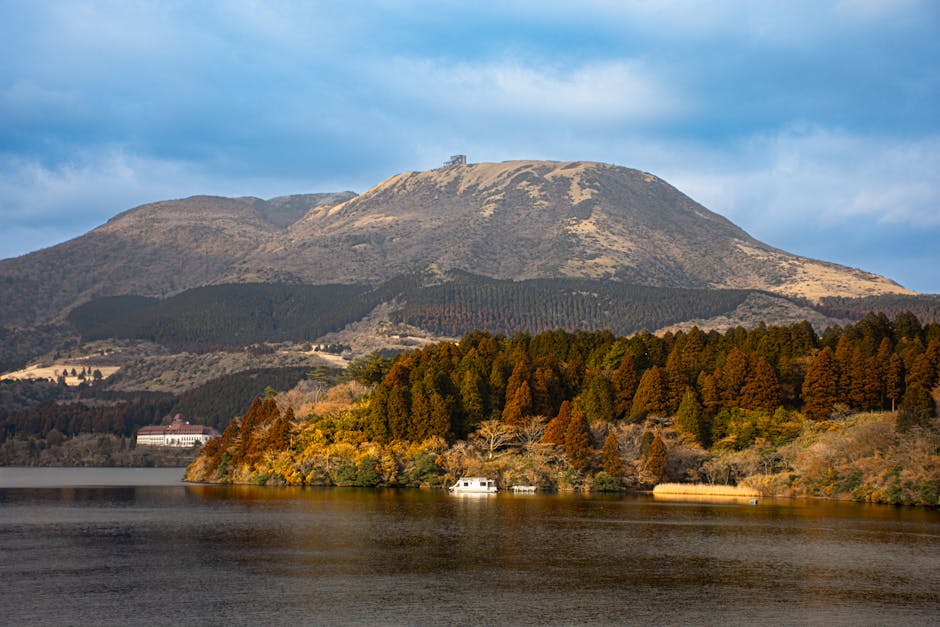
Touge, Onsen & Mt. Fuji Views: The Ultimate Hakone Driving Route from Shibuya
If there’s one drive that perfectly captures everything magical about Japan — sweeping mountain roads, volcanic landscapes, sacred shrines reflected in mirror-still lakes, and the iconic snow-capped silhouette of Mt. Fuji — it’s this one. The route from Tokyo out to Hakone is legendary among car enthusiasts, and once you’ve tackled the twisting tarmac of the Hakone Turnpike with Fuji looming on the horizon, you’ll understand exactly why. This isn’t just a sightseeing trip. This is a driving experience.
What makes this route particularly special is the variety it packs into a single day. You’ll roll through the historic castle town of Odawara, soak in the steaming mineral waters of Hakone Yumoto Onsen, walk among bubbling sulfur vents at Owakudani where the legendary black eggs are said to add seven years to your life, cruise along the shores of Lake Ashi past a torii gate that seems to float on the water, and then — the grand finale — climb the Hakone Turnpike, a sinuous stretch of touge-style road that car lovers travel from across the world to experience. It’s the kind of route that makes you want to extend your rental by another day just so you can drive it again.
The best part? You can kick the whole adventure off right in the heart of Tokyo. Grab your rental car in Shibuya, hit the expressway heading southwest, and within 90 minutes you’ll feel like you’ve left the city entirely behind. Whether you’re here for the onsen, the mountain scenery, or the pure joy of driving a proper Japanese sports car through legendary Kanagawa touge, this route delivers on every single promise.
Route Overview
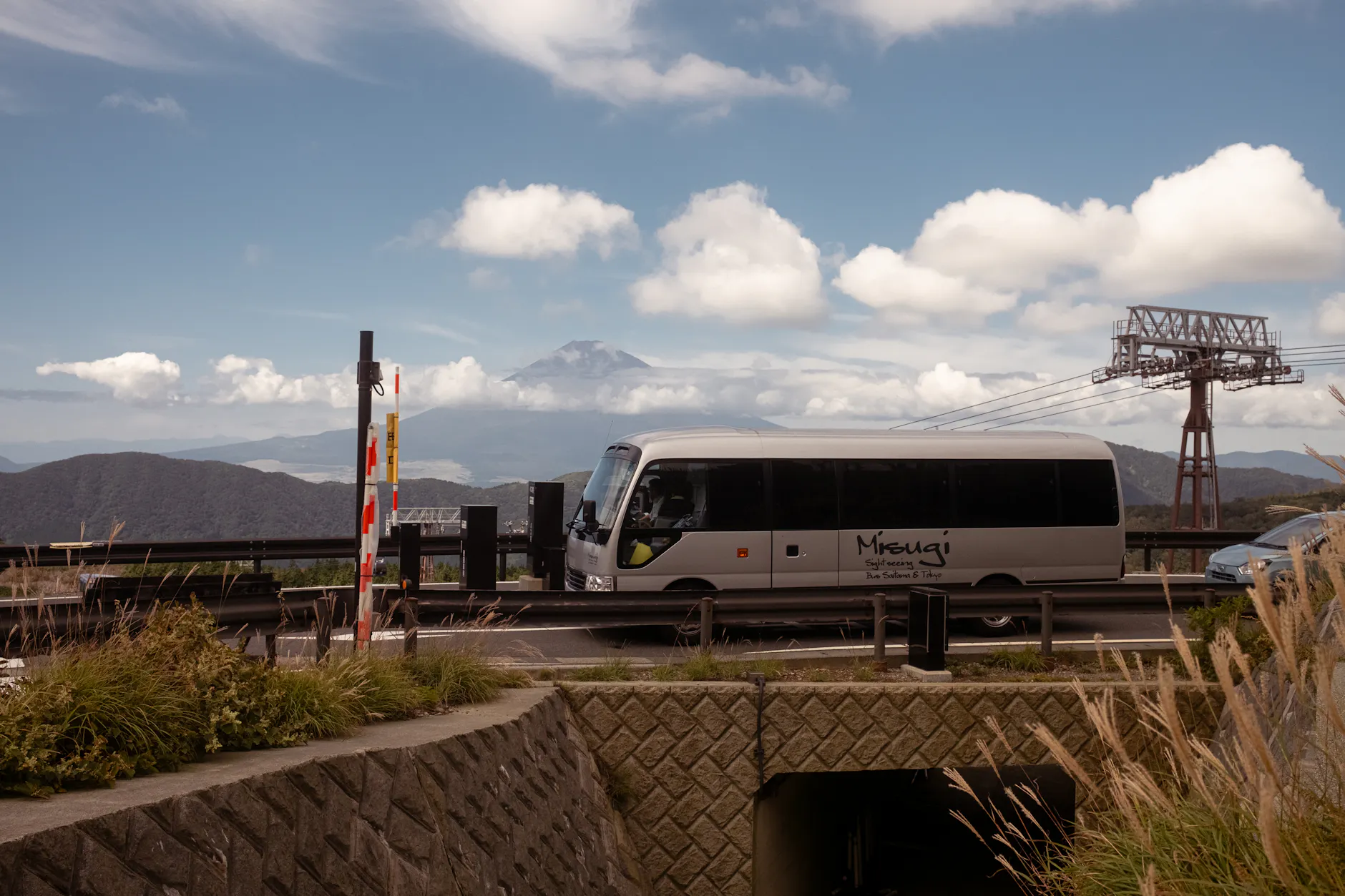
This is a looping mountain route that takes you from central Tokyo deep into the Hakone volcanic highlands and back. The total driving distance is roughly 130–150 km depending on your return route, and the full day including stops will run comfortably from morning to early evening. Here’s the breakdown:
- Pick up your rental car at Samurai Car Japan in Shibuya, Tokyo — Start your engines
- Shibuya → Odawara — Approx. 80 km via the Tomei Expressway (E1) or Odawara-Atsugi Road (Route 271) | ~75–90 minutes
- Odawara → Hakone Yumoto Onsen — Approx. 15 km via National Route 1 then Route 138 | ~25 minutes
- Hakone Yumoto → Owakudani — Approx. 14 km via the Hakone Skyline / Izu-Hakone Road area, or via Route 1 and the toll road approach | ~30–40 minutes
- Owakudani → Lake Ashi (Moto-Hakone) — Approx. 7 km via Route 1 descending to the lakeside | ~15 minutes
- Lake Ashi → Hakone Turnpike Summit — Approx. 10 km via the Hakone Turnpike (toll road) from the Odawara-Atsugi Road entrance | ~20–25 minutes drive up
- Return to Shibuya — Via Odawara-Atsugi Road and Tomei Expressway | ~90 minutes
Total estimated driving time (excluding stops): 4–5 hours
Recommended full-day time: Depart Shibuya by 7:30–8:00 AM, return by 7:00–8:00 PM
Toll costs: Expect to spend approximately ¥3,000–¥5,000 in total expressway and road tolls (ETC rates apply)
🗺️ Open This Route in Google Maps
Opens in Google Maps app on mobile
Stop 1: Odawara — Castle Town Gateway to Hakone
Your first stop after leaving Tokyo is Odawara, and even if you’ve driven this stretch of the Tomei Expressway before, the approach never gets old. As the urban sprawl of greater Tokyo gradually thins out and the hills of Kanagawa start rising around you, there’s a genuine sense of leaving the city behind. Odawara sits at the foot of the Hakone mountains, and it’s been a strategically important town since the feudal era — most famously as the seat of the powerful Hojo clan and home to one of Japan’s most impressive castle reconstructions.
Odawara Castle (Odawara-jo) is the star attraction here, a striking white tenshu (keep) that dates in its current reconstructed form to 1960 but sits on grounds with history stretching back to the 15th century. The castle park is beautiful year-round, with cherry blossoms in spring and a great elevated view of the surrounding town. It’s worth 45–60 minutes to walk the grounds and pop inside the museum if you’re interested in samurai history.
Beyond the castle, Odawara is famous for kamaboko (fish cakes) — a local specialty you’ll see sold at shops throughout the old town centre. The covered shopping arcade near the station is a great place to grab a quick snack and stretch your legs before the mountain roads begin in earnest.
- Recommended time: 45–90 minutes
- Parking: Use the Odawara Castle Park Municipal Parking Lot (城址公園市営駐車場) directly adjacent to the castle grounds. Cost is approximately ¥200–¥300 per 30 minutes, with a daily maximum around ¥1,500. It can fill up on weekends — arrive before 9:30 AM to be safe.
- The drive from Shibuya: Take the Shuto Expressway (C2/C3) connecting to the Tomei Expressway (E1) heading southwest. Exit at Odawara-Nishi IC (Odawara West) for the most direct approach to the castle area. The expressway section is straightforward — four lanes, well-signed, and mostly smooth flowing if you depart before 8:00 AM. Toll cost for this stretch is approximately ¥1,800–¥2,200 (standard rate; lower with ETC).
Stop 2: Hakone Yumoto Onsen — The Grand Hot Spring Gateway
From Odawara, take National Route 1 east then branch off onto Route 138 (Hakone Tozan Road) heading into the valley. This short stretch is where the character of the drive completely transforms. The road narrows, the trees close in on both sides, and you start following the course of the Hayakawa River upstream into the mountains. It’s only about 15 km from Odawara, but those kilometres feel like a genuine transition from the coastal flatlands into a different world.
Hakone Yumoto is the largest hot spring resort town in the entire Hakone region, and it’s been welcoming weary travellers since the Edo period when it served pilgrims and merchants walking the old Tokaido highway. Today it’s a lively resort strip packed with ryokan, day-use bath houses, souvenir shops, and restaurants. Even if you’re not staying overnight, Hakone Yumoto is absolutely worth a stop for a quick onsen soak — several facilities offer day-use bathing (日帰り入浴) for around ¥1,000–¥1,500 per person.
While you’re here, keep your eyes open for the signposted Old Tokaido Road (旧東海道) trailhead. This stone-paved section of the ancient highway that once connected Tokyo (Edo) and Kyoto is one of the most atmospheric historic walks in all of Kanagawa. Cedar trees that are centuries old line the path, and the worn stones underfoot carry the weight of millions of footsteps from samurai, merchants, and court messengers. Even a 20-minute walk along this section is deeply evocative.
- Recommended time: 1–2 hours (longer if you do a full onsen soak)
- Parking: The Hakone Yumoto Station municipal parking area is the most convenient option, located near the Odakyu Hakone Yumoto Station. Rates are approximately ¥200–¥300 per 30 minutes. There are also several private lots along the main resort street — look for the blue parking signs (P). Weekend afternoons can be tight, so aim to arrive before 11:00 AM.
- The drive from Odawara: Route 1 is a conventional two-lane national highway — nothing dramatic yet, but well-maintained and pleasant. Watch for tour buses on the narrower riverside sections.
Stop 3: Owakudani — Volcanic Valley with Black Eggs and Fuji Views
Leaving Hakone Yumoto, the road begins to climb in earnest. To reach Owakudani, you have a couple of options depending on your route preference. The most scenic approach is via the Hakone Skyline (箱根スカイライン) and the connecting roads around the caldera rim — a series of sweeping curves at elevation with increasingly dramatic views. Alternatively, Route 1 climbs over the Hakone Pass before connecting to the roads that circle back toward the volcanic zone. Either way, the ascent is genuinely exciting driving.
Owakudani — literally “Great Boiling Valley” — is one of those places that genuinely earns its dramatic name. This is an active volcanic area formed about 3,000 years ago when Mt. Hakone erupted and created a vast caldera. Sulphur vents hiss and billow white steam across a moonscape of pale grey rock, and the entire valley smells of rotten eggs (in the best possible way, somehow). It’s simultaneously eerie and utterly spectacular.
The star attraction is the famous kuro-tamago (黒玉子) — black eggs hard-boiled in the volcanic hot springs. The sulphur reacts with iron in the spring water to turn the shells jet black, and local legend holds that eating one adds seven years to your life. They’re sold in bags of five for around ¥600 and honestly taste like perfectly cooked hard-boiled eggs, but the experience of eating them amid the steaming vents is absolutely worth it.
More importantly for those who’ve come chasing the money shot: on a clear day, Mt. Fuji rises magnificently above the ridge to the northwest, framed by the volcanic plumes below. It’s one of the most iconic views in all of Hakone, and the large observation plaza is specifically positioned to make the most of it. Early morning and late afternoon tend to offer the clearest Fuji views — midday haze can obscure the peak, especially in summer.
- Recommended time: 45–75 minutes
- Parking: The Owakudani Ropeway Station parking area is the main option, with approximately 100 spaces. Cost is around ¥500–¥800 for a few hours. This lot fills up quickly on weekends — try to arrive before 10:00 AM or after 2:00 PM. There is an overflow lot slightly further down the hill.
- The drive from Hakone Yumoto: The climb up through the Hakone mountain zone via the toll road section involves a series of tight hairpins — wonderful touge-style driving with guardrails and forest on both sides. Take your time, enjoy the corners, and pull into the designated viewpoint lay-bys for photo stops.
Driving this route? We’ve got you covered.
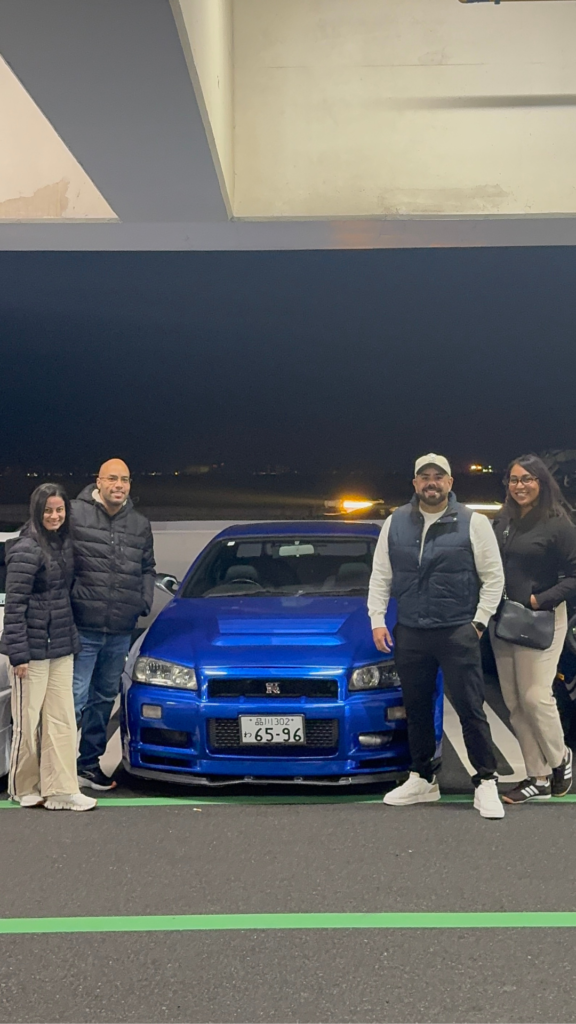
Hundreds of international visitors have driven this route with a car from Samurai Car Japan. Our team will brief you on road conditions, tolls, and the best stops before you set off.
Stop 4: Lake Ashi — Torii Gates, Pirate Ships, and Mt. Fuji Reflections
Descending from Owakudani toward the shores of Lake Ashi, the landscape opens up dramatically. The road drops through a series of well-paced curves, and if the sky is cooperating, you’ll catch your first glimpse of the lake glinting below through gaps in the forest — with the unmistakable cone of Mt. Fuji positioned perfectly above the far shore. This is genuinely one of those views that stops your breath mid-corner.
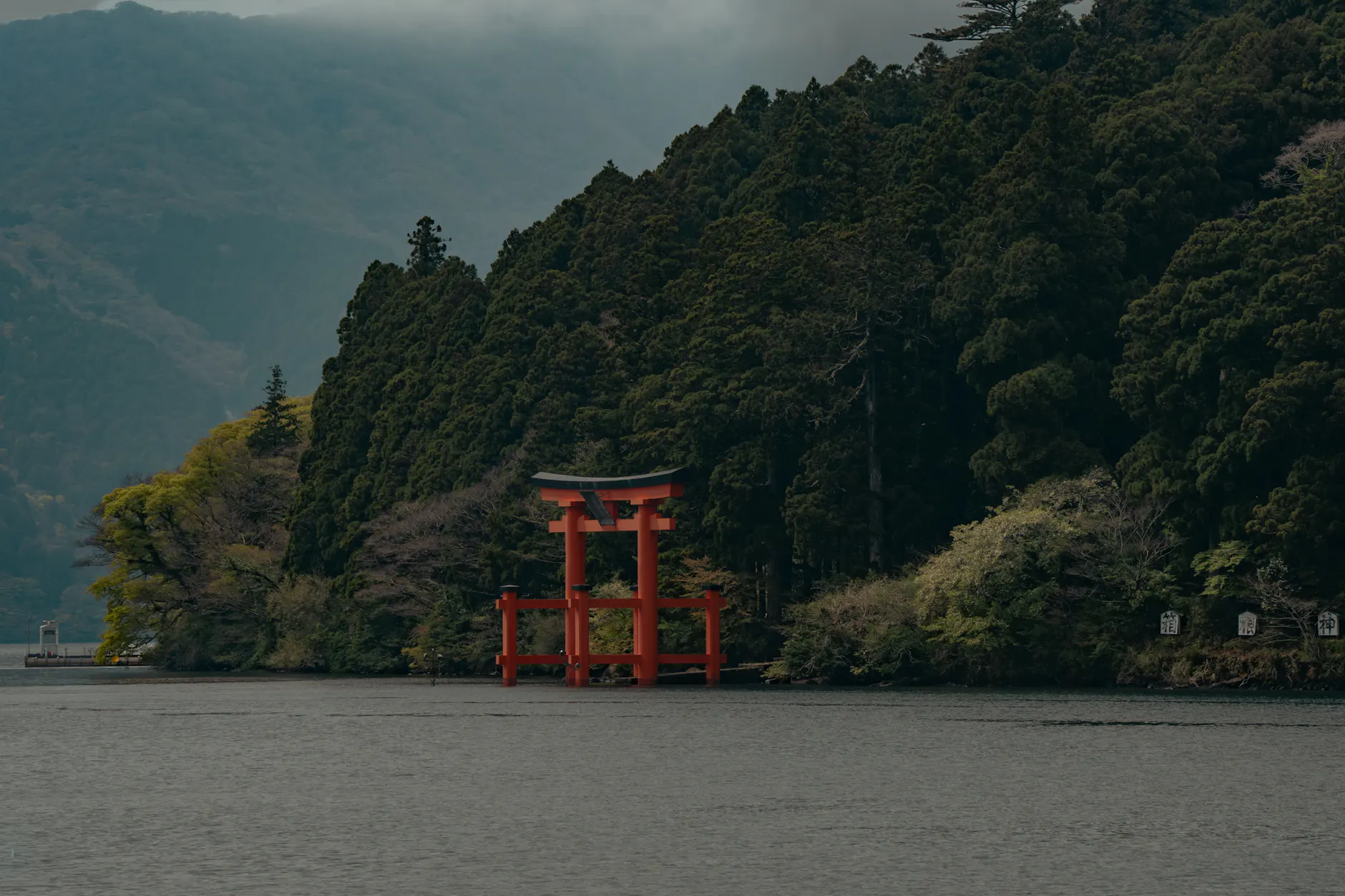
Lake Ashi (芦ノ湖) — also called Ashinoko — sits in the caldera at an elevation of around 723 metres. It’s a classic caldera lake: deep, still, and brilliantly reflective on calm mornings. The most famous image from this entire region is the view of Hakone Shrine’s red torii gate standing in the water near the Moto-Hakone shore, with Mt. Fuji rising beyond it. It’s the kind of photograph that belongs on travel posters, and seeing it in person absolutely lives up to the image.
Head to Moto-Hakone (元箱根) on the southeastern shore for the torii gate — you can walk right down to the water’s edge and stand beside it at low water. The full Hakone Shrine (箱根神社) is set back slightly in the trees, approached via a long cedar-lined stone staircase that feels ancient and otherworldly. Allow at least 30 minutes to walk the shrine grounds properly.
If you’re travelling with family or simply want a different perspective on the lake, the famous pirate ship sightseeing boats (海賊船) operate regular crossings between Moto-Hakone, Hakone-machi, and Togendai on the northern shore. A one-way adult ticket costs around ¥1,200 and the 30-minute crossing gives you extraordinary views back toward Mt. Fuji. You won’t need the car for this — just park up and hop aboard.
- Recommended time: 60–90 minutes
- Parking at Moto-Hakone: There are several private parking lots along the Moto-Hakone waterfront road, typically charging ¥500–¥800 flat rate for visits. The lots closest to the shrine can fill up by mid-morning on weekends. A slightly larger municipal parking area is located a short walk south along the lake road.
- The drive from Owakudani: The descent via Route 1 toward Moto-Hakone is a gorgeous stretch — wide sweeping curves on a well-maintained road with lake and mountain views. Keep your speed measured; the road is used by tour buses and cyclists as well as private cars.
Stop 5: Hakone Turnpike Summit — The Legendary Touge Finish
Save the best for last. The Hakone Turnpike (箱根ターンパイク) — now officially rebranded as the ODAKYU HAKONE TURNPIKE but still known universally by its original name — is without question the most exciting piece of road on this entire route, and one of the most celebrated driving roads in all of Japan. Car enthusiasts from across the country make pilgrimages here specifically for this road. If you’re behind the wheel of a JDM sports car, this is your moment.
The Hakone Turnpike is a dedicated toll road that winds its way up through the mountains from the coastal side near Odawara all the way to a summit area at approximately 1,090 metres elevation. The road is approximately 15 km long and features a superb sequence of flowing curves, tight hairpins, and long sweeping sections that reward smooth, committed driving. The surface is well-maintained, the guardrails are solid, and on a weekday morning you may find the road pleasantly uncrowded.
To incorporate the Turnpike into this route after Lake Ashi, head from Moto-Hakone back toward the Odawara-Atsugi Road (小田原厚木道路) and access the Turnpike from the Hakone Turnpike entrance (箱根口 IC) near Odawara. The toll for a standard passenger vehicle is approximately ¥720–¥800 one way (cash or ETC). Drive up to the summit rest area and observation plaza for the most spectacular Mt. Fuji views on the entire route — at this elevation, on a clear day, Fuji dominates the entire northwestern horizon in a way that is frankly overwhelming.
The summit zone has a decent rest facility with a café, a gift shop, and — crucially — wide open parking areas that draw serious car spotters every weekend. You’ll often find beautifully maintained GT-Rs, NSXs, and Supras lined up in the lot while their owners admire the view and each other’s builds. If you’ve rented a JDM sports car, you’ll fit right in.
- Recommended time at the summit: 30–45 minutes
- Parking: Free parking at the Turnpike Summit Rest Area. Large capacity — this is where the car meet culture of Hakone is centred. Plenty of space even on weekends.
- Toll: Approximately ¥720–¥800 per car, one way (ETC pricing may vary slightly). Cash payment available at the toll booth.
- Return from the summit: You can descend the same way and connect back to the Odawara-Atsugi Road for the expressway return to Shibuya. Total drive back is approximately 90 minutes via the Tomei Expressway.
Driving Tips for This Route
Road Conditions and Skill Level
This route is suitable for most drivers with a valid international driving permit and basic highway experience. The expressway sections (Tomei, Odawara-Atsugi) are straightforward and well-signposted in both Japanese and English. The mountain sections around Hakone involve tighter roads with more elevation change — nothing technically demanding, but you should be comfortable with narrow lanes, hairpin bends, and the occasional tour bus coming the other way.
International Driving Permit (IDP)
Foreign visitors driving in Japan must carry a valid International Driving Permit alongside their home country driving licence. Japan recognises IDPs issued under the 1949 Geneva Convention — check that your home country issues this specific version. You can obtain an IDP from your local automobile association before travelling. Note that IDP holders from certain countries (including Switzerland, Germany, France, Belgium, Monaco, and Slovenia) need a Japanese translation of their licence instead — check the current requirements with the Japan Automobile Federation (JAF) before your trip.
ETC Cards and Tolls
An ETC (Electronic Toll Collection) card is strongly recommended for this route. ETC lanes are faster, offer slightly discounted rates on many expressways, and avoid the hassle of having exact change ready at manual toll booths. Samurai Car Japan includes an ETC card with rentals, which is genuinely one of the most practically useful things about renting locally before a mountain drive like this.
Fuel Stations
Fill up in Odawara or before entering the Hakone mountain zone — fuel stations become sparse once you’re in the highlands around Owakudani and Lake Ashi. ENEOS and Idemitsu stations are well distributed along National Route 1 between Odawara and Hakone Yumoto. Fuel prices in 2024–2025 are approximately ¥170–¥185 per litre for regular petrol.
Best Time to Drive
Depart Shibuya no later than 8:00 AM to avoid the worst of the morning traffic on the Tomei Expressway. Weekdays are significantly less congested than weekends throughout the Hakone area. If driving on a weekend or national holiday, expect parking lots at Owakudani and Lake Ashi to be near capacity by 10:30 AM.
Where to Eat Along the Route
Odawara
- Suzuhiro Kamaboko Village (鈴廣かまぼこの里) — A fantastic stop near the Odawara-Nishi IC exit, this kamaboko (fish cake) producer runs a large complex with a restaurant, food hall, and sake bar. Try the fresh-grilled chikuwa and kamaboko boards. Open from 9:00 AM, great for a late breakfast or early lunch.
- Odawara fish market area — Fresh seafood at reasonable prices near the port. Excellent sashimi sets for around ¥1,200–¥1,800.
Hakone Yumoto
- Tochien (橙家) — A beloved local soba restaurant near the station area, serving handmade buckwheat noodles in a beautiful traditional setting. The duck soba is outstanding. Lunch only; expect a short wait on weekends.
- Hatago Ichi (旅籠一) — Serves Hakone-style kaiseki cuisine and excellent local mountain vegetable dishes. Midrange pricing; reservations recommended on weekends.
Owakudani
- The Owakudani black egg (kuro-tamago) stall is the essential food stop here — bags of five eggs for approximately ¥600. There’s also a café at the ropeway station serving black curry (dyed with squid ink to match the egg theme) and hot drinks.
Lake Ashi / Moto-Hakone
- Amazake Chaya (甘酒茶屋) — A historic rest house on the Old Tokaido Road near Moto-Hakone, serving traditional amazake (sweet fermented rice drink) and mochi since the Edo period. Atmospheric beyond belief, and the amazake is warming and delicious on a cool mountain day. Cash only; very modest pricing (around ¥450 per cup).
- Naraya Café — A stylish café-gallery near the Hakone-Yumoto side of Lake Ashi, with excellent coffee and light meals in a converted old building. Popular with the design-conscious crowd.
Hakone Turnpike Summit
- The summit rest facility café serves decent coffee, soft-serve ice cream, and simple hot meals — think curry rice, udon, and sandwiches. Nothing gourmet, but the views from the terrace make any food taste better. Good for a final coffee before the descent.
Best Season for This Drive
Spring (March–May) ⭐⭐⭐⭐⭐
Arguably the best time of year. Cherry blossoms typically peak around the Odawara Castle grounds in late March to early April, and the mountain scenery transitions through a gorgeous palette of fresh greens into May. Mt. Fuji still holds its winter snowcap well into April and sometimes May, making for the most dramatic summit views from both Owakudani and the Turnpike. Roads are fully clear and temperatures are ideal for driving with the windows down.
Summer (June–August) ⭐⭐⭐
Summer is the busiest period with domestic Japanese holiday travellers filling the Hakone resorts. Rainy season (tsuyu) runs June into mid-July — expect low clouds and reduced Fuji visibility. Post-rainy season in late July and August brings beautiful clear mornings but hazy afternoons. The mountain elevation keeps temperatures cooler than central Tokyo. Watch for potential road closures after heavy rains.
Autumn (September–November) ⭐⭐⭐⭐⭐
Peak foliage season transforms the Hakone highlands into a blaze of red, orange, and gold, typically from mid-October through mid-November. This is one of the most beautiful times to drive the mountain roads — the colours lining the Turnpike and the approach roads to Owakudani are stunning. Expect heavier weekend crowds during peak koyo (autumn leaves) season. Early mornings on weekdays are the sweet spot.
Winter (December–February) ⭐⭐⭐⭐
Winter brings the clearest Fuji views of the year — cold, dry air produces exceptional visibility, and the snow-covered peak is at its most magnificent against deep blue winter skies. The Turnpike and higher roads may occasionally close due to ice or snowfall — check road conditions before departure via the NEXCO East Japan road information hotline or the Kanagawa Prefecture road information site. Carry an ETC card and check ahead; snow chains or winter tyres may be required on some sections.
Frequently Asked Questions
Where can I rent a car for this route?
The most convenient option for this specific route is Samurai Car Japan in Shibuya, Tokyo. They specialise in self-drive rentals for international visitors and offer full International Driving Permit support, ETC cards, and English GPS navigation as standard. If you want to drive something truly special — a Nissan GT-R, Toyota Supra, Mazda RX-7, or similar JDM icon — through the Hakone mountains, they have sports car options available that will make this route genuinely unforgettable. You can pick up the car directly in Shibuya and be on the Tomei Expressway heading toward Odawara within minutes. Visit samuraicarjapanjdm.jp to check availability and reserve.
How long does the full route take?
Allow a full day — approximately 10–12 hours including all stops, sightseeing, an onsen soak, meals, and the Turnpike drive. Departing Shibuya by 7:30–8:00 AM and returning by 7:00–8:00 PM is a comfortable pace. If you want to spend more time at any particular stop (especially Hakone Yumoto for a proper onsen or Lake Ashi for the shrine and pirate boat), consider splitting across two days with an overnight ryokan stay in Hakone.
Is the Hakone Turnpike difficult to drive for beginners?
The Hakone Turnpike is a purpose-built toll road in good condition, not a narrow mountain pass. The lower and middle sections involve tight hairpin bends, but they’re wide enough for standard vehicles and well-guardrailed. If you’re comfortable driving on mountain roads in general and have driven on the left side of the road for at least a day before attempting it, you’ll be fine. The upper sections are more open and flowing. Take your time, use your mirrors, and pull over at designated viewpoints rather than trying to drive and sightsee simultaneously.
Can I do this route on a weekday or should I avoid weekends?
Weekdays are significantly more enjoyable for the driving portions of this route — less traffic on the expressways, easier parking at every stop, and a much more relaxed atmosphere on the mountain roads themselves. If a weekend is your only option, depart before 7:30 AM to beat the worst congestion and arrive at Owakudani and Lake Ashi before the crowds peak. National holidays (particularly Golden Week in late April/early May and Silver Week in September) see the highest visitor volumes and should be approached with an especially early start.
Do I need a Hakone Free Pass if I’m driving?
The Hakone Free Pass is primarily designed for travellers using public transport within the Hakone area (trains, ropeways, buses, pirate boats). If you’re driving your own rental car, you won’t need the pass for road access — you’ll simply pay individual tolls at the Turnpike and expressway booths using your ETC card or cash. However, if you plan to use the pirate boat on Lake Ashi or the Hakone Ropeway to Owakudani, purchasing the relevant ride tickets individually or picking up a Free Pass for the activity portions only can be worth doing. Ask at your rental shop for current pass options.
Why not elevate your journey with a legendary JDM experience?
Our Services:
- Self-Drive Rentals
- Guided Tours
- Drift Experiences
Please visit the dedicated page for more details.
[st_af id=”862″]
Book a Hot Spring Day Trip
Escape Tokyo and relax in Hakone’s famous hot springs. Includes transport, scenic views of Mt. Fuji, and onsen access. Free cancellation.
Related Articles
- Mt Fuji Climbing Guide: Routes, Gear and When to Go
- Hakone Hot Spring Day Trip from Tokyo
- Mt Fuji Day Trip from Tokyo
[st_af id=”854″]
🇯🇵 Plan Your Japan Experience
JDM Car Rental
Drive a GT-R, Supra, RX-7, or Silvia on the roads they were built for. Hakone passes, Wangan highway, mountain touge — your dream JDM experience.
Daikoku PA Tour
Visit Japan’s most legendary car meet. Hundreds of modified cars, passionate owners, and the heartbeat of JDM culture. Guided weekend night tours available.
Photo Guide Tour
Capture stunning photos at locations only locals know. Hidden shrines, backstreet alleys, rooftop views, and golden hour spots for unforgettable shots.
Leave a Reply