Things to Do in Osaka: 20 Best Experiences in Japan’s Food Capital (2026)
Osaka has a reputation in Japan that no other city quite matches: a place where people are louder, friendlier, and more obsessed with food than anywhere else in the country. The Osakans themselves have a word for it — kuidaore, which translates roughly as “eat yourself into ruin.” In a city where locals will happily debate the correct thickness of takoyaki batter or the optimal char on a piece of kushikatsu, this is not hyperbole. It is a lifestyle.
But Osaka is far more than a food city. It is Japan’s second commercial center, a place that has been a trading hub since the 7th century, with a castle that defines the skyline, a nightlife district that never really closes, a standing-comedy culture (manzai) that has shaped Japanese humor for a century, and a network of covered shopping arcades that could keep you occupied for an entire week. It is also the best base for day trips to Kyoto (30 minutes), Nara (40 minutes), Hiroshima (1.5 hours by shinkansen), and Kobe (30 minutes).
This guide covers the 20 best things to do in Osaka in 2026, with practical information on prices, hours, and how to get the most out of Japan’s most underrated major city.
1. Dotonbori — The Beating Heart of Osaka
Dotonbori is the canal district that most people picture when they think of Osaka: neon signs reflecting off dark water, mechanical crabs and blowfish rotating above restaurant entrances, the Glico Running Man sign illuminating the bridge. It is Osaka’s most visited area and with good reason — the energy is genuinely different from anywhere else in Japan.
The main strip runs along Dotonbori Canal for about 500 meters, with Ebisu Bridge at its center. At night, the neon reflections on the canal create one of Japan’s most photographed scenes. During the day, the same streets function as an enormous outdoor food market, with restaurants serving everything from 100-yen takoyaki to multi-course kaiseki at street level.
Walk Dotonbori at night, eat your way through it during the day, and spend an evening exploring the smaller alleys branching north and south from the main canal — where the locals actually eat.
2. Osaka Castle — The City’s Defining Landmark
Osaka Castle (Osaka-jo) is the single most recognizable image of the city and one of Japan’s most impressive castle complexes. The main tower stands 58 meters tall and is surrounded by massive stone walls, a moat, and 106 hectares of parkland. Originally built by Toyotomi Hideyoshi in 1583 as the physical symbol of his unification of Japan, the castle has been destroyed and rebuilt several times — the current structure is a 1931 reconstruction with a modern interior museum.
The interior of the castle houses a museum covering the history of Hideyoshi and the Osaka Castle. The top floor observation deck offers sweeping views over the city and surrounding Osaka Castle Park — one of the largest and most pleasant urban green spaces in Japan.
Admission: 600 yen (castle tower); park is free
Hours: 9:00 AM – 5:00 PM (last entry 4:30 PM)
Getting there: Subway Chuo or Tanimachi Line to Tanimachi 4-chome Station (5-minute walk)
3. Kuromon Ichiba Market — Osaka’s Kitchen
Kuromon Ichiba Market (Kuromon Market) is a 580-meter covered shopping arcade in Namba that has served as Osaka’s primary fresh food market for nearly 200 years. Where Nishiki Market in Kyoto has shifted heavily toward tourist-oriented snacks, Kuromon still functions as a working market where Osaka’s restaurant owners buy their fish, meat, and produce each morning.
Over 150 shops and stalls line the arcade, selling fresh seafood, Kobe beef, Wagyu, aged tofu, pickled vegetables, and Osaka specialty foods. Many stalls offer on-the-spot preparation — fresh sea urchin scooped from the shell, maguro tuna sliced to order, giant oysters grilled at the counter. Come hungry and expect to spend 2,000–4,000 yen on a morning’s eating.
Hours: 8:00 AM – 6:00 PM (most stalls); market busiest 9:00 AM – 1:00 PM
Getting there: Subway Sennichimae or Sakaisuji Line to Nippombashi Station (2-minute walk)
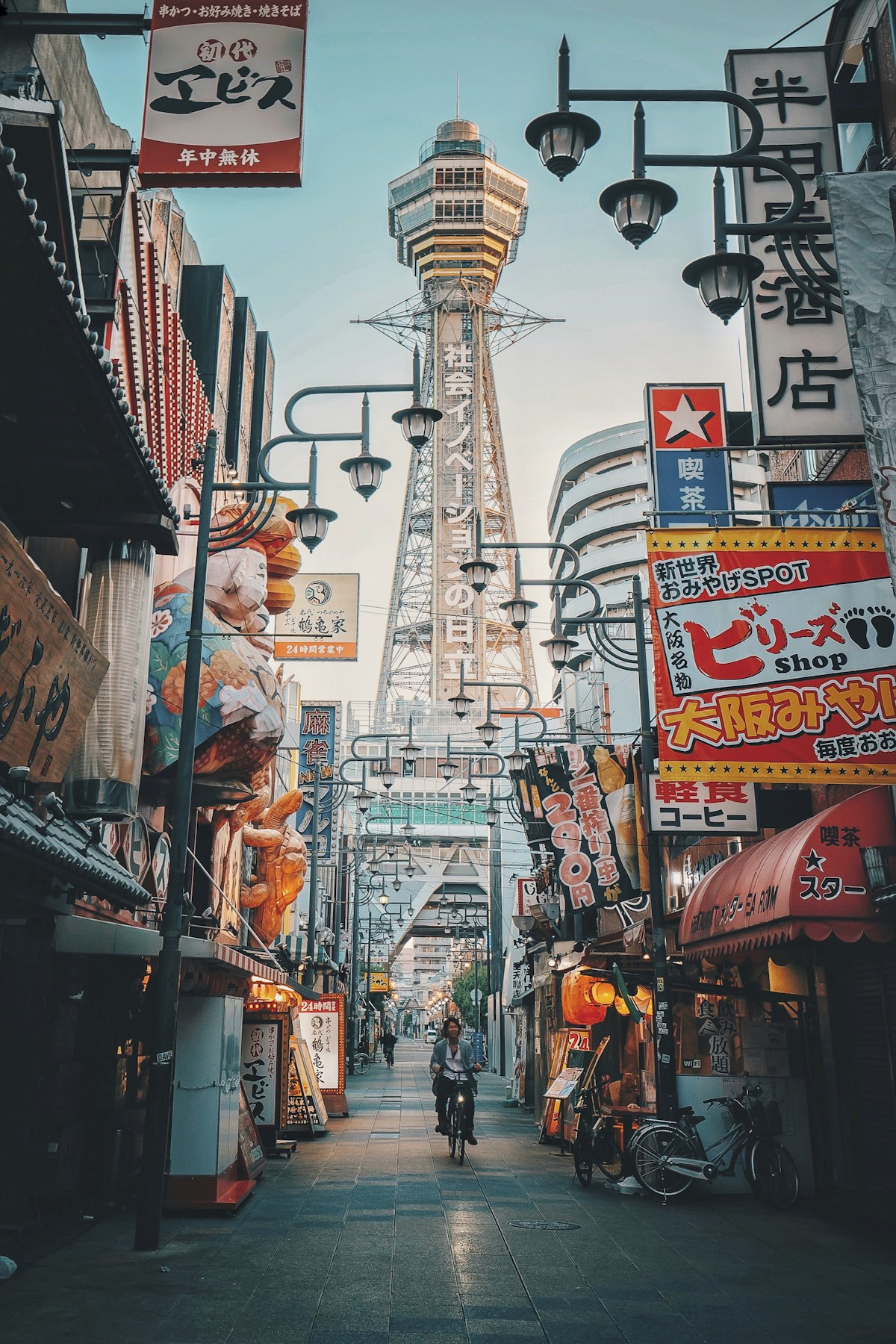
4. Shinsekai — Osaka’s Retro Downtown
Shinsekai (meaning “New World”) was built in 1912 as a futuristic entertainment district modeled simultaneously on Paris (for the northern section) and Coney Island (for the southern section). Today it is decidedly retro — a low-rise district of kushikatsu restaurants, old-school pachinko parlors, vintage neon signs, and the Tsutenkaku Tower rising above it all.
Shinsekai is the spiritual home of kushikatsu — battered and deep-fried skewers of meat, vegetables, and seafood. The golden rule of kushikatsu etiquette is posted in every restaurant: no double-dipping in the communal sauce. Breaking this rule will earn you a telling-off from the chef. Following it will earn you a plate of the most satisfying fried food you have had in years.
5. Namba — Osaka’s Entertainment Hub
Namba is the entertainment and commercial center of Osaka, encompassing Dotonbori, the covered Shinsaibashi and Namba shopping arcades, Amerikamura (a district of vintage clothing, street fashion, and independent music), and dozens of department stores and underground shopping malls that connect beneath the streets.
The covered Shinsaibashi-suji shopping arcade — running north from Namba to Shinsaibashi — is over 600 meters long and has operated as a shopping street since the 17th century. It is the best place in Osaka for mainstream shopping, running alongside the more interesting independent shops of Amerikamura one block to the west.
6. Universal Studios Japan
Universal Studios Japan (USJ) in Osaka’s Sakurajima district is one of Asia’s most popular theme parks, consistently ranked as one of the top theme parks in the world. The park’s main draw for international visitors is The Wizarding World of Harry Potter, an exceptionally detailed reproduction of Hogsmeade village with Butterbeer on tap and Hogwarts Castle housing a ride. The Super Nintendo World area — the first in the world when it opened in 2021 — brings the Mario universe into physical reality with rides, interactive challenges, and a Power-Up Band that tracks your points.
Admission: From 8,600 yen (day pass, prices vary by date)
Hours: Typically 9:00 AM – 9:00 PM (varies by season)
Getting there: JR Yumesaki Line direct to Universal City Station (5-minute walk)
7. Tsutenkaku Tower — Symbol of Shinsekai
Tsutenkaku Tower is Osaka’s retro icon — a 103-meter tower in the center of Shinsekai that has been rebuilt and reimagined several times since 1912. The current tower (built 1956) houses a museum about Osaka’s history, a Billiken (the “God of Things as They Ought to Be”) statue on the viewing platform, and an observation deck with views over the Shinsekai district and Tennoji Park below.
The tower is less impressive as a viewpoint than as a cultural artifact — climbing it gives context to the surrounding district and offers a legitimately retro experience that the polished observation decks of modern Osaka cannot.
Admission: 800 yen (standard observation); 1,000 yen (outdoor terrace)
Hours: 10:00 AM – 8:00 PM daily
8. Osaka Aquarium Kaiyukan — One of the World’s Great Aquariums
Kaiyukan is consistently ranked among the world’s finest aquariums. The central tank — the Pacific Ocean tank — is 9 meters deep, 34 meters long, and houses whale sharks, manta rays, and thousands of fish that you view from an eight-level spiral walkway descending around the tank. The aquarium also maintains dedicated tanks for Antarctic penguins, Japanese spider crabs (which can reach 3.5 meters leg span), and sea otters, among others.
Admission: 2,400 yen adults; 1,200 yen children
Hours: 10:00 AM – 8:00 PM (last entry 7:00 PM)
Getting there: Subway Chuo Line to Osaka-ko Station (Tempozan Wharf exit, 5-minute walk)
9. Tennoji Zoo and Tennoji Park
Tennoji Zoo is one of Japan’s oldest zoos (1915) and maintains over 1,000 animals across 11 hectares adjacent to Tennoji Park. The zoo is genuinely good — well-maintained with thoughtful habitat design — and is one of the most visited in Japan. Tennoji Park surrounds it with gardens, a pond, and the Osaka City Museum of Fine Arts, all within walking distance of Shinsekai and Tsutenkaku.
Admission: 500 yen
Hours: 9:30 AM – 5:00 PM (closed Mondays)
10. Osaka Food Tour — What to Eat in Osaka
No guide to Osaka is complete without a dedicated section on the food. Osaka’s kuidaore culture means the city has produced and perfected a specific set of dishes that you owe it to yourself to try:
- Takoyaki — octopus-filled batter balls cooked in a special cast-iron mold, topped with bonito flakes, mayo, and Worcestershire-style sauce. Osaka’s unofficial dish.
- Okonomiyaki — a savory pancake of batter, cabbage, and your choice of ingredients (pork belly, seafood, cheese), cooked on a griddle and topped with okonomi sauce and Japanese mayo. Osaka-style is mixed and cooked together; Hiroshima-style is layered.
- Kushikatsu — battered and deep-fried skewers (see Shinsekai, above). Originally working-class food, now a Osaka institution.
- Kitsune udon — thick wheat noodles in a light dashi broth topped with sweetened fried tofu (aburaage). Osaka’s contribution to Japanese noodle culture.
- Fugu — pufferfish, which is highly poisonous if improperly prepared. Osaka is the safest city in Japan to try it — the highest concentration of licensed fugu chefs is here.
11. Shinsaibashi and Amerikamura
Shinsaibashi is Osaka’s main luxury shopping district, with flagships from every major Japanese and international fashion brand along the covered arcade. One block west, Amerikamura (America Village, known as “Amemura” locally) is the antithesis — a maze of vintage clothing stores, record shops, independent sneaker boutiques, and street art centered on Triangle Park, where Osaka’s youth culture has gathered since the 1970s.
12. Nakanoshima — Osaka’s Cultural Island
Nakanoshima is a narrow island in the Dojima River in central Osaka, home to the Osaka City Hall, the Osaka Prefecture Nakanoshima Library (a 1904 neoclassical building), the Museum of Oriental Ceramics (housing one of the world’s finest collections of Chinese and Korean ceramics), and Nakanoshima Park, where the rose garden blooms in May.
Walking the length of Nakanoshima takes about 30 minutes and gives a sense of Osaka that Dotonbori’s neon never could — the quiet, institutional, civic Osaka that has functioned as a commercial and administrative center for over a millennium.
13. Sumiyoshi Taisha — Osaka’s Oldest Shrine
Sumiyoshi Taisha is one of Japan’s oldest Shinto shrines, predating Buddhism’s arrival in Japan and serving as the model for a “Sumiyoshi-style” of architecture found in over 2,000 shrines across the country. The famous arched drum bridge (Soribashi) spanning the pond in front of the main hall is steep enough that crossing it requires careful footwork — locals consider crossing it a form of purification.
Unlike Osaka’s commercial and entertainment areas, Sumiyoshi Taisha is genuinely quiet — a working shrine where Osakans come to pray, not pose. It rewards a slower visit.
Admission: Free
Getting there: Nankai Main Line to Sumiyoshi Taisha Station (2-minute walk)
14. Hozenji Yokocho — Osaka’s Best Hidden Alley
Hozenji Yokocho is a narrow stone-paved alley two minutes from Dotonbori, lined with traditional restaurants and bars that have operated here for generations. The alley centers on Hozenji Temple, where a moss-covered Fudo Myo-o statue stands in a tiny courtyard. Visitors ladle water over the statue to make wishes — centuries of this ritual have given the statue a thick covering of green moss that has become its defining feature.
The surrounding restaurants are excellent and significantly cheaper than Pontocho in Kyoto for equivalent quality. This is where Osaka’s restaurant and bar workers eat after their own shifts end.
15. Osaka Museum of Housing and Living
The Osaka Museum of Housing and Living (Osaka Kurashino Konjakukan) is an unusual museum: a full-scale recreation of an Edo-period Osaka downtown neighborhood, with streets, shops, and residences populated with mannequins going about daily life circa 1843. The recreation occupies an entire floor of a modern building in Tenjimbashi and is designed to walk through, not observe from behind barriers.
It is one of Osaka’s most underrated attractions — genuinely immersive, detailed, and almost entirely free of the foreign tourist crowds that pack Osaka’s main sites.
Admission: 600 yen
Hours: 10:00 AM – 5:00 PM (closed Mondays)
16. Day Trip to Kyoto from Osaka
Kyoto is 30 minutes from Osaka by the Hankyu or Kintetsu lines (400–680 yen) or 15 minutes by shinkansen (1,420 yen, not covered by most rail passes for this short segment). The proximity makes a day trip to Kyoto from Osaka one of the most efficient itinerary choices available in Japan: stay in Osaka (cheaper accommodation, better nightlife), and take the train to Kyoto for temples and traditional culture.
For everything worth seeing in Kyoto, see our Things to Do in Kyoto guide.
17. Day Trip to Nara from Osaka
Nara is 40 minutes from Osaka by the Kintetsu Nara Line (580 yen) — even easier from Osaka than from Kyoto. The 1,200 deer roaming freely through the temple complex at Nara Park remain one of Japan’s most genuinely surprising experiences even after seeing thousands of photos. See our Nara Park Guide for the full visit breakdown.
18. Osaka’s Nightlife — Where to Go After Dark
Osaka has no legal closing time for bars, and several areas operate essentially 24 hours. Namba is the most accessible nightlife district — concentrated bars, restaurants, and clubs. Shinsaibashi has the club scene, with several basement venues running until 5:00 AM or later. Kitashinchi, north of Osaka Station, is the traditional business entertainment district — expensive hostess clubs alongside high-quality whisky bars.
For something more local, the area around Fukushima Station (3 minutes from Osaka Station) is where Osaka’s chefs and food industry workers drink after service — a collection of standing bars (tachinomi), small izakayas, and sake bars that close whenever the last customer leaves.
19. Explore by Bike or Boat
Osaka was historically a canal city — once called the “Venice of the East” for its network of waterways. Most of the canals were filled in during postwar reconstruction, but Dotonbori Canal and the river network remain, and exploring them by water gives a fundamentally different perspective on the city.
The Tombori River Cruise is a 20-minute boat ride through the Dotonbori canal system, narrated in Japanese with visual displays. Boats depart from a dock near Ebisu Bridge. For cycling, PiPPA and Docomo Bike Share operate dock-free e-bike rentals across the city (300 yen per 30 minutes) that are excellent for reaching Tennoji and Sumiyoshi from Namba.
20. Experience Osaka from the Water — Cruise the Rivers
The Osaka Aqua Bus operates sightseeing cruises along the Osaka river network, including routes passing Osaka Castle, Nakanoshima, and the Tempozan waterfront. The 60-minute round-trip cruise leaves from Okawa riverbank near Osaka Castle and provides a clean view of the castle, the Nakanoshima buildings, and the Yodogawa riverbanks that is genuinely different from any land-based perspective.
Fare: From 1,500 yen
Departure: Hachikenyamonjo Pier, near Osaka Castle Park
Practical Information for Visiting Osaka
How to Get to Osaka
Osaka is served by Kansai International Airport (KIX), which handles most international flights. The airport is connected to the city by the Haruka Limited Express (75 minutes to Osaka Station, 2,850 yen) and the Nankai Electric Railway to Namba (38 minutes, 1,460 yen). From Tokyo, the shinkansen Nozomi takes 2 hours 30 minutes (14,720 yen). The journey from Kyoto is just 15 minutes by shinkansen or 30 minutes by Hankyu express train. See our Tokyo to Osaka Guide for full transport options.
Many visitors combine Osaka with a Tokyo road trip. Samurai Car Japan in Tokyo’s Shibuya district offers JDM sports car rentals — GT-R, Supra, and RX-7 — that turn the Tokyo portion of any Japan trip into something genuinely memorable before heading west to Osaka by rail.
Getting Around Osaka
Osaka’s subway system is clean, efficient, and covers the entire city. The Osaka Metro operates eight lines; a one-day pass (800 yen) covers unlimited rides and is worth buying if you plan to cross the city more than twice. IC cards (Suica, ICOCA) work everywhere. Taxis are plentiful and reasonably priced by Japanese standards.
Where to Stay in Osaka
- Namba/Shinsaibashi: Best for nightlife, Dotonbori, and southern Osaka. Walking distance to Shinsekai and Kuromon Market.
- Umeda/Osaka Station: Best transport connections. More business hotel oriented but centrally located for day trips.
- Tennoji: Quieter, cheaper, excellent for Shinsekai and day trips to Nara.
Frequently Asked Questions
How many days do I need in Osaka?
Two full days covers Osaka’s main attractions (Dotonbori, Osaka Castle, Kuromon Market, Shinsekai). Three days adds day trips to Kyoto or Nara. Using Osaka as a base for 4–5 days lets you day-trip to Kyoto, Nara, Hiroshima, and Kobe without moving accommodation.
Is Osaka or Kyoto better?
They are fundamentally different cities that complement each other perfectly. Kyoto is for temples, traditional culture, and quiet beauty. Osaka is for food, nightlife, and contemporary Japanese urban life at its most vibrant. Most visitors to the Kansai region benefit from spending time in both. See our Osaka 3-Day Itinerary for a structured approach to the city.
Is Osaka safe for tourists?
Osaka is extremely safe by international standards — Japan’s crime rates are among the lowest in the developed world. The main practical concerns are the same as any large city: watch your belongings in crowded areas and be aware of your surroundings in the nightlife districts late at night.
Can I get by in Osaka without speaking Japanese?
Yes. Osaka’s major attractions, transport systems, and most restaurants in tourist areas have English signage and staff. Google Translate’s camera function handles menus effectively. Osakans are generally considered the friendliest and most outgoing people in Japan — even with a complete language barrier, navigating the city is rarely difficult.